OANA RINALDI · FIELD NOTES · 3 MIN READ
The anatomy of a four-dimensional puzzle
Position, orientation and remembered actions each answer a different question.
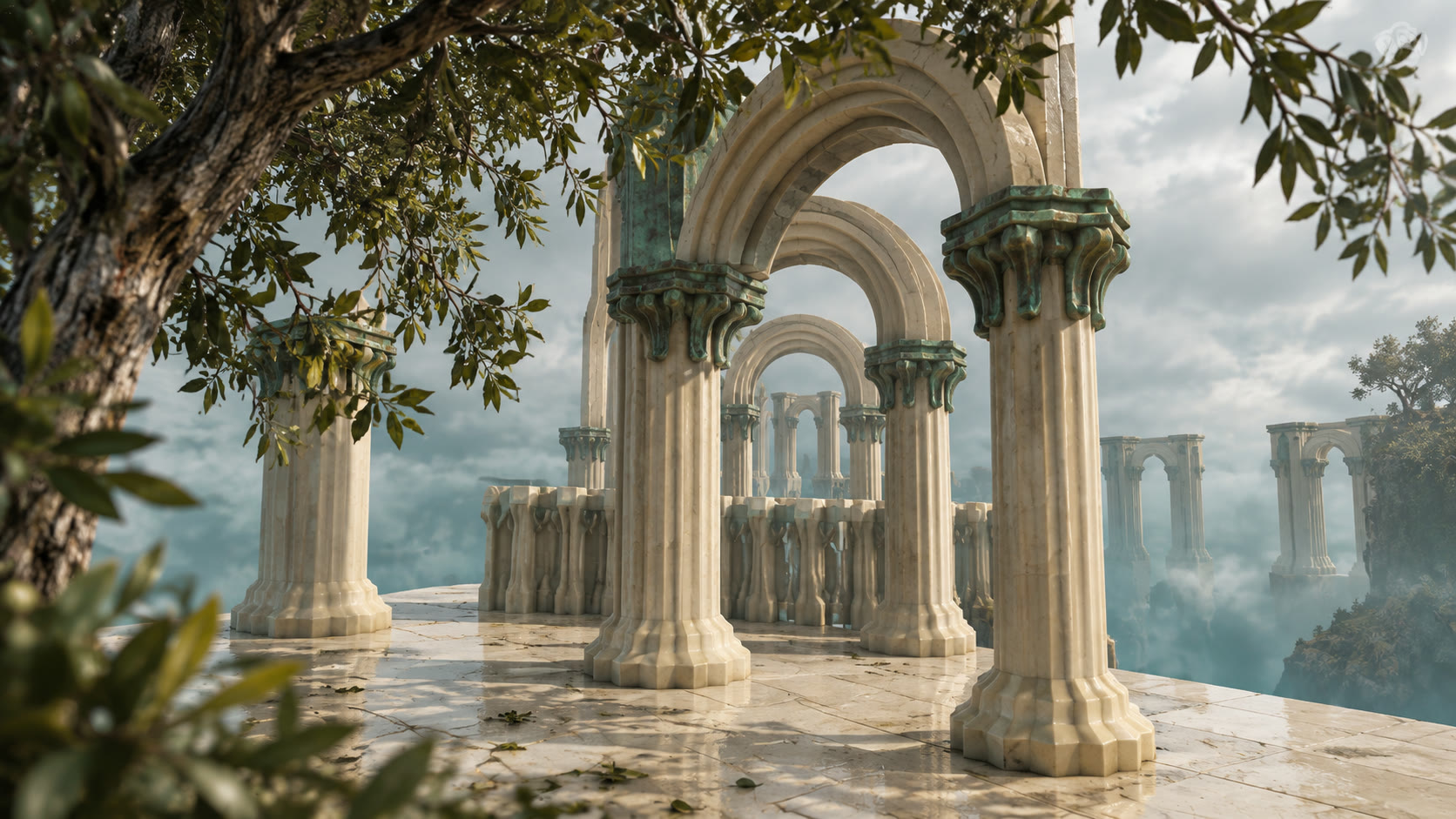
Three questions hide inside one objective
A glowing mechanism may look close and still refuse to activate. The game is checking more than its location in the picture. Are you nearby in four-dimensional space? Does this rite require a particular orientation? Have you completed the action that makes it available?
These are three different kinds of state: position, orientation and progress. Separating them makes an unfamiliar puzzle easier to diagnose. Walking solves a positional problem. Turning solves an orientation problem. Carrying an object or completing a previous rite solves a progress dependency.
Near on screen is not necessarily near in space
The distance between two positions includes all four coordinates:
If two points share x, y and z but differ by three units in w, their four-dimensional distance is three. A projection could place them on top of one another; that does not make them touch. The game uses 4D distance for quest interactions, and its interface reports a target’s depth relative to the current frame.
In the current implementation, most rites require the player to come within 1.3 world units of the target. Discovery rites also have an automatic pickup check at a slightly smaller distance. The practical lesson is to approach the objective in space, rather than aim only for its apparent screen position.
What the different rites ask of you
| Rite | What matters | A useful question |
|---|---|---|
| Discover | Proximity to the current target | Is its depth close to my slice? |
| Lens / Resonance | Proximity and the required frame | Have I aligned more than one direction? |
| Carry / Deliver | Acquiring and retaining the relic state | Did I collect the vessel first? |
| Echo | Completing the designated echo rite | What changed after I left the echo? |
Lens and resonance checks compare all four basis directions with their target directions. A single angle readout cannot fully describe the result of a sequence of turns. The alignment indicator helps distinguish “I found it” from “I oriented it correctly.”
A remembered action can change the route
Completed rites are stored in sequence. Some trigger a seal to move out of the relevant region and become non-solid. A carried relic is represented by a progress state; delivery checks that state. Echoes leave a visible marker that appears near its stored slice depth. In this version, an echo is not an autonomous second player performing a separate simulation.
This distinction gives the fantasy a clear mechanical reading. A route can be blocked because of geometry, because the next rite is unfinished, or because a particular frame is required. Repeating the same movement will not resolve every kind of obstacle.
A route around the unseen edge
Imagine a wall that occupies only −1 ≤ w ≤ 1. If the surrounding floor permits it, moving beyond that interval can let you pass around the wall before returning to the original slice. Your character has not become intangible. The route avoids the wall’s full extent, and the collision model still checks the hidden coordinate.
When stuck: read the current rite, inspect distance and depth, test one small turn, and check whether an earlier action is still required. Use the chamber library when you want a full solution.
Research connection: the game-mechanics report’s discussion of interacting rules and progression. The specific conditions here come from Aetherfold’s QuestRuntime, Campaign and movement code.